NCERT Solutions Class 10 Maths 2026-2027
Table of Contents
- NCERT Solutions for Class 10 Maths Chapter-wise
- CBSE Class 10 Maths Board Exam Weightage — Chapter-Wise Marks Distribution
- What Has Been Removed From the Class 10 Maths Syllabus for the Current Session?
- Important Questions to Practise for CBSE Class 10 Exam (Chapter-Wise)
- CBSE Marking Scheme for Class 10 Maths — How Each Step Is Graded
- CBSE Class 10 Maths Exam Pattern 2026

eSaral › NCERT Solutions Class 10 › NCERT Solutions for Class 10 Maths 2026-2027

NCERT Solutions for Class 10 Maths Chapter-wiseMentioned below are the NCERT Class 10 Maths chapters
|
CBSE Class 10 Maths Board Exam Weightage — Chapter-Wise Marks Distribution
Which Chapters Carry the Most Marks in the Class 10 Maths Board Exam?
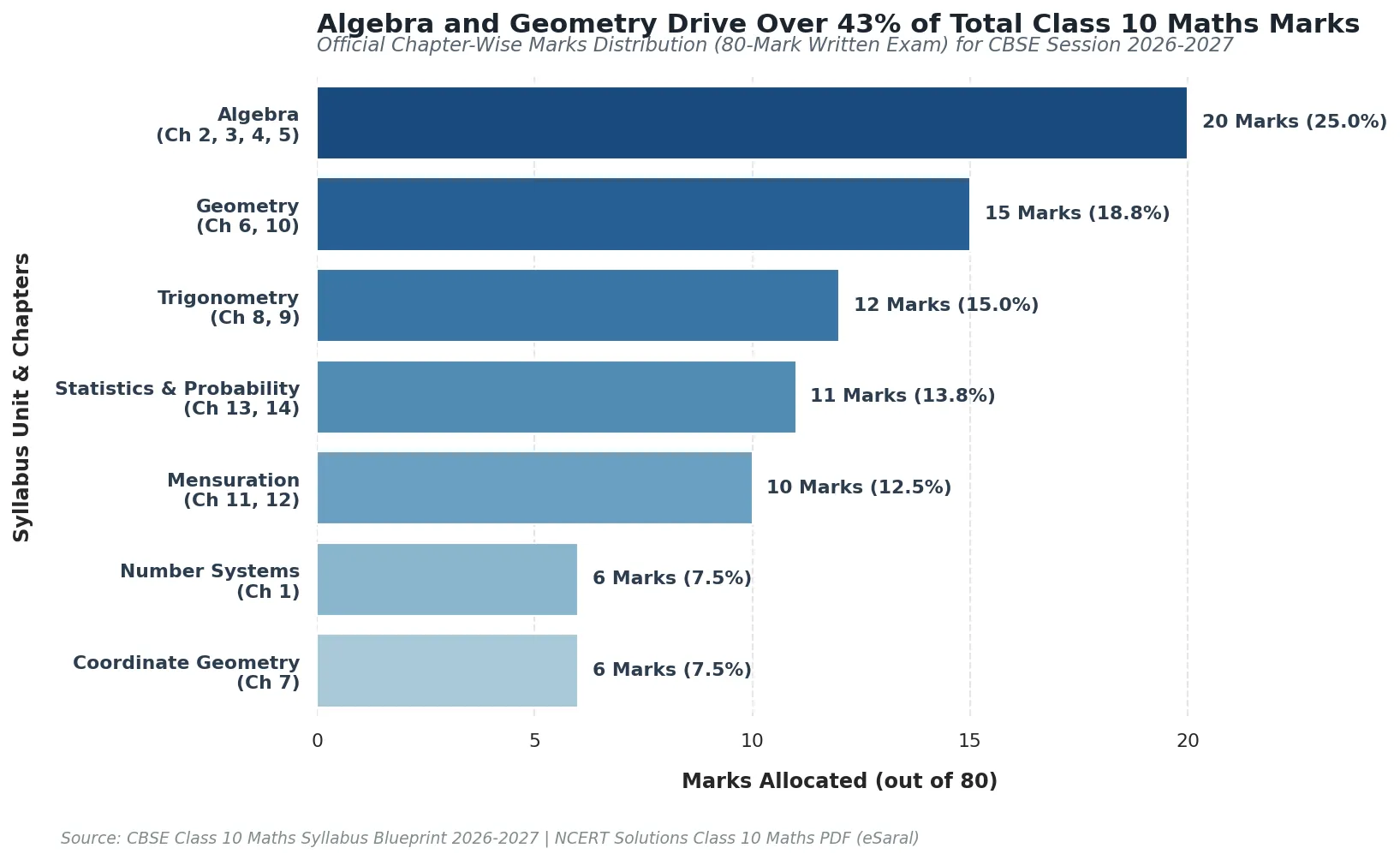
The CBSE Class 10 Maths board paper carries 80 marks in the written exam (plus 20 marks internal assessment), split across seven units. Algebra alone accounts for a quarter of the entire paper, which is exactly why NCERT Solutions Class 10 Maths for Chapters 2 to 5 deserve the most repeated practice of any section on this page.
| Unit | NCERT Chapters Covered | Approximate Marks |
|---|---|---|
| Number Systems | Chapter 1 – Real Numbers | 6 |
| Algebra | Chapter 2 – Polynomials, Chapter 3 – Pair of Linear Equations, Chapter 4 – Quadratic Equations, Chapter 5 – Arithmetic Progressions | 20 |
| Coordinate Geometry | Chapter 7 – Coordinate Geometry | 6 |
| Geometry | Chapter 6 – Triangles, Chapter 10 – Circles | 15 |
| Trigonometry | Chapter 8 – Introduction to Trigonometry, Chapter 9 – Applications of Trigonometry | 12 |
| Mensuration | Chapter 11 – Areas Related to Circles, Chapter 12 – Surface Areas and Volumes | 10 |
| Statistics & Probability | Chapter 13 – Statistics, Chapter 14 – Probability | 11 |
| Total | 80 |
This distribution follows CBSE's published Class 10 Maths blueprint and stays broadly consistent year to year, with variations of only 1–2 marks in any given unit. Always cross-check the exact split against the current year's CBSE sample paper before finalising your revision plan.
How to Use This Table While Studying NCERT Solutions Class 10 Maths
Don't read this table as "skip the low-weightage chapters." A 6-mark unit like Coordinate Geometry is usually asked as short, formula-based questions — meaning it's often the fastest marks on the entire paper. Use the weightage table to decide how many hours you spend per chapter, not whether you study it at all.
What Has Been Removed From the Class 10 Maths Syllabus for the Current Session?
CBSE Class 10 Maths — Topics Removed From the Current Syllabus
As part of CBSE's syllabus rationalisation, several exercises and one full chapter have been dropped from the Class 10 Maths assessment. These deletions are meant to lighten the load so students can focus their revision time only on what will actually be tested.
| Chapter | Topics No Longer in the Syllabus |
|---|---|
| Real Numbers | Euclid's Division Lemma; decimal expansion of rational numbers (terminating and non-terminating recurring) |
| Polynomials | Division algorithm for polynomials and its applications |
| Pair of Linear Equations in Two Variables | Graphical method of solving equations; cross-multiplication method; equations reducible to linear form |
| Quadratic Equations | Solving by the method of completing the square |
| Triangles | Theorem on areas of similar triangles; Pythagoras theorem and its converse |
| Coordinate Geometry | Finding the area of a triangle using coordinates |
| Introduction to Trigonometry | Trigonometric ratios of complementary angles |
| Constructions | Entire chapter removed from the syllabus |
| Surface Areas and Volumes | Frustum of a cone; conversion of one solid shape into another |
| Statistics & Probability | Cumulative frequency distribution and the ogive; one optional probability exercise |
Important 2026–27 Update: CBSE's New Two-Attempt Exam Policy
Starting with the 2026–27 academic session, CBSE is introducing a two-attempt board exam system for Class 10. Students will sit for a main exam in February–March 2027, with the option of a second attempt in May 2027 — whichever of the two scores is higher will count as the final result. This gives students a genuine safety net: a weak main-exam performance no longer has to define the year, since there's a real second chance built into the system itself.
Important Questions to Practise for CBSE Class 10 Exam (Chapter-Wise)
This list covers the question types that repeatedly carry the most weight within each chapter, based on CBSE's marking pattern — not a copied past-paper list, but a study-priority guide for what to master first.
Chapter 1 – Real Numbers
- Prove irrationality of a given number using Euclid's Division Lemma
- Find HCF and LCM using the Fundamental Theorem of Arithmetic
Chapter 2 – Polynomials
- Find zeroes of a quadratic polynomial and verify the relationship with coefficients
- Form a quadratic polynomial when the sum and product of zeroes are given
Chapter 3 – Pair of Linear Equations in Two Variables
- Solve word problems by forming a pair of linear equations (age, speed, or fraction-based)
- Check consistency of a pair of equations graphically or algebraically
Chapter 4 – Quadratic Equations
- Solve using the quadratic formula and verify using the discriminant
- Word problems involving time, work, or speed leading to a quadratic equation
Chapter 5 – Arithmetic Progressions
- Find the nth term or sum of n terms given specific AP conditions
- Application-based AP word problems (savings, seating arrangement, etc.)
Chapter 6 – Triangles
- Prove similarity of triangles using AA, SAS, or SSS criteria
- Apply the Basic Proportionality Theorem (Thales) in numerical problems
Chapter 7 – Coordinate Geometry
- Find the distance between two points or the area of a triangle formed by given points
- Find coordinates of a point dividing a line segment in a given ratio (section formula)
Chapter 8 – Introduction to Trigonometry
- Prove trigonometric identities using standard ratios
- Evaluate trigonometric expressions involving specific angles (0°, 30°, 45°, 60°, 90°)
Chapter 9 – Some Applications of Trigonometry
- Height and distance problems involving angle of elevation and depression
- Two-triangle combined problems (observer height, tower/building pairs)
Chapter 10 – Circles
- Prove the tangent-radius perpendicularity theorem
- Problems involving the length of tangents from an external point
Chapter 11 – Areas Related to Circles
- Find the area of a sector or segment given a specific angle
- Combined figure problems (area of a shape made from circle parts and polygons)
Chapter 12 – Surface Areas and Volumes
- Find surface area/volume of combined solids (cone + hemisphere, cylinder + cone, etc.)
- Frustum of a cone — surface area and volume problems
Chapter 13 – Statistics
- Find mean, median, and mode of grouped data
- Draw and interpret a cumulative frequency (ogive) curve
Chapter 14 – Probability
- Find probability of simple events (cards, dice, coins)
- Word problems combining probability with real-life scenarios (bag of balls, defective items)
NCERT Solutions Class 10 Maths
NCERT Class 10 Maths Chapter 1 Real Numbers
In Chapter 1, Real Numbers of Class 10, you will explore real numbers and irrational numbers. The chapter begins with Euclid’s Division Lemma, which states that “Given positive integers a and b, there exist unique integers q and r satisfying a = bq + r, 0≤r In chapter 2 Polynomials, it begins with the definition of the degree of the polynomial, linear polynomial, quadratic polynomial and cubic polynomial. This chapter has a total of 4 exercises, including miscellaneous exercise. Exercise 2 includes questions on finding the number of zeroes through a graph. It requires a basic understanding of the Geometrical Meaning of the Zeroes of a Polynomial. Exercise 2.2 is based on the Relationship between Zeroes and Coefficients of a Polynomial, where you have to find the zeros of a quadratic polynomial and in some of the questions, they have to find the quadratic polynomial. In Exercise 2.3, the concept of the division algorithm is defined, and you will find the questions related to this topic. The optional exercise, 2.4, contains the questions from all the concepts of Chapter 2. This chapter explains the concept of Pair of Linear Equations in Two Variables. This chapter consists of a total of 7 exercises, and in these exercises, different methods of solving the pair of linear equations are described. Exercise 3.1 explains how to represent a situation algebraically and graphically. Exercise 3.2 describes the methods of solving the pair of the linear equation along with the Graphical Method. Exercises 3.3, 3.4, 3.5 and 3.6 describe the Algebraic Method, Elimination Method, Cross-Multiplication Method, and Substitution Method, respectively. Exercise 3.7 is an optional exercise that contains all types of questions. You must practise these exercises to secure good marks in your board exams. NCERT Solutions Pair of Linear Equations in Two Variables Class 10 Maths Exercise 3.1 NCERT Solutions Pair of Linear Equations in Two Variables Class 10 Maths Exercise 3.2 NCERT Solutions Pair of Linear Equations in Two Variables Class 10 Maths Exercise 3.3 In chapter 4 Quadratic Equations, you will get to know the standard form of writing a Quadratic Equation. The chapter goes on to describe the method of solving the quadratic equation through completing the square method and factorization method . It ends with the topic on finding the nature of roots, where you will get to know what is a quadratic equation ax² + bx + c = 0 has Two distinct real roots, if b² – 4ac > 0 Two equal roots, if b² – 4ac = 0 No real roots, if b² – 4ac < 0 NCERT Solutions Maths Quadratic Equations Class 10 Exercise 4.1 NCERT Solutions Maths Quadratic Equations Class 10 Exercise 4.2 NCERT Solutions Maths Quadratic Equations Class 10 Exercise 4.3 In this chapter you will introduced to a new topic, Arithmetic Progression, i.e. AP. This chapter has a total of 4 exercises. In Exercise 5.1, the questions related to representing a situation in the form of AP, finding the first term and difference of an AP, and finding out whether a series is AP or not. Exercise 5.2 includes the questions on finding out the nth term of an AP by using the following formula: an = a + (n-1) d The next exercise, which is 5.3, contains the questions on finding the sum of the first n terms of an AP. The last exercise contains miscellaneous questions which are high level questions based on AP to enhance your problem-solving skills and analytical. In Chapter 6 of Class 10 Maths, you will learn about triangles, triangles with same shape but with different angles. This chapter starts with the concept of a similar and congruent figure. It will explain the condition for the similarity and theorems of two triangles and theorems related to the similarity of triangles. further, the areas of similar triangles have been explained with a theorem. At the end you will learn about the Pythagoras Theorem and the Converse of Pythagoras Theorem. Important theorems that you should know thoroughly while preparing for the exam include: Theorem 1: If a line is drawn parallel to one side of a triangle to intersect the other two sides in distinct points, the other two sides are divided in the same ratio. Theorem 2: If a line divides any two sides of a triangle in the same ratio, then the line is parallel to the third side. Theorem 3: If in two triangles, corresponding angles are equal, then their corresponding sides are in the same ratio (or proportion) and hence the two triangles are similar. Theorem 4: If in two triangles, sides of one triangle are proportional to (i.e., in the same ratio of) the sides of the other triangle, then their corresponding angles are equal and hence the two triangles are similar. Theorem 5: If one angle of a triangle is equal to one angle of the other triangle and the sides including these angles are proportional, then the two triangles are similar. NCERT Solutions Class 10 Maths Triangles Class 10 Exercise 6.1 NCERT Solutions Class 10 Maths Triangles Class 10 Exercise 6.2 NCERT Solutions Class 10 Maths Triangles Class 10 Exercise 6.3 In chapter 7, you will learn how to find the distance between two points whose coordinates are already given, and to find the area of the triangle formed by three given points. Along with this, you will also know how to find the coordinates of the point which divides a line segment joining two given points in a given ratio. NCERT Solutions Class 10 Maths Coordinate Geometry Class 10 Exercise 7.1 NCERT Solutions Class 10 Maths Coordinate Geometry Class 10 Exercise 7.2 Trigonometry Introduced in chapter 8 to the student in NCERT textbook. You will study some ratios of a right triangle with respect to its acute angles called trigonometric ratios of the angles. Also, the trigonometric ratios for angles 0∘ and 90∘. You will also learn to calculate trigonometric ratios for the given angles and also a few trigonometric identities. This chapter 9 is the continuation of the previous chapter; here, you will study the applications of trigonometry. It is used in so many ways such as: geography, navigation, construction of maps, and determining the position of an island in relation to the latitudes and longitudes. In this chapter, we will see how trigonometry is used for finding the heights and distances of several objects without actually measuring them. NCERT Solutions Class 10 Maths Some Applications of Trigonometry Class 10 Exercise 9.1 In chapter 10, you will be introduced to the concept of tangents and the number of tangents from a point on a circle. Important Theorems – Theorem 1: The tangent at any point of a circle is perpendicular to the radius through the point of contact. Theorem 2: The lengths of tangents drawn from an external point to a circle are equal. NCERT Solutions Class 10 Maths Circles Class 10 Exercise 10.1 NCERT Solutions Class 10 Maths Circles Class 10 Exercise 10.2 As per the name of the chapter, it is all about the perimeter and area of a circle. The concepts of finding the area of a sector and segment of a circle are discussed here. Further, this chapter explains how to find the area of the figures that contain a circle or part of a circle. NCERT Solutions Class 10 Maths Areas Related to Circles Class 10 Exercise 11.1 Chapter 13 is about the surface areas and volumes of different shapes and objects. There are a total of 5 exercises in this chapter. Find the surface area of any object which is 2-dimensional or 3-dimensional. The 3-dimensional shapes include cuboid, cone, sphere, hemisphere and cylinder. After that, there are questions on finding the volume of the objects that are made up of two different solid shapes. Also, in this chapter, you will get questions on conversion from one shape to another. This chapter discusses how to find the volume, curved surface area and total surface area of a frustum of a cone. NCERT Solutions Class 10 Maths Surface Areas and Volumes Exercise 12.1 NCERT Solutions Class 10 Maths Surface Areas and Volumes Exercise 12.2 In this chapter 13, you will learn the numerical representation of ungrouped data to grouped data and you will get to know how to find the Mean, Mode and Median. Also, the concept of cumulative frequency, cumulative frequency distribution and how to draw cumulative frequency curves will be clarified. This is the last chapter of class 10 NCERT Maths which deals with Probability. This chapter starts with the theoretical approach of probability. Later, the chapter explains the difference between experimental probability and theoretical probability. There are several examples given to explain it in an effective way. So, before going through the exercise problems, you must solve the examples of this book first CBSE Class 10 Maths follows a step-marking system, not an all-or-nothing final-answer system. This is exactly why every NCERT Solutions Class 10 Maths answer on this page is written out step-by-step rather than jumping straight to the result — copying only the final number teaches you nothing about how those marks are actually earned. A student who writes the correct formula, substitutes values correctly, but makes a small arithmetic slip in the last line can still earn 80–90% of that question's marks under CBSE's scheme. A student who writes only the final answer with no working — even if it happens to be correct — risks losing marks entirely in some question formats, since there's no method shown to award credit against. This is the single biggest reason to study the full working shown in NCERT Solutions Class 10 Maths rather than memorising final answers. The biggest shift in recent sessions isn't the total marks or duration — it's the growing share of competency-based questions (CBQs), which test whether a student can apply a Maths concept to an unfamiliar, real-world-style scenario rather than reproduce a memorised textbook method. A student who has only memorised NCERT exercise answers without understanding why each step works will struggle disproportionately on the CBQ portion, which is precisely why working through the reasoning in each NCERT Solutions Class 10 Maths answer — not just the final number — matters more under the current pattern than it did a few years ago. You can explore all subject-wise solutions on eSaral's NCERT Solutions hub — including solutions for Class 11 Physics and Class 12 Physics for students planning.
Class 10 Maths NCERT Chapter 1 Real Numbers Exercises
NCERT Class 10 Maths Chapter 2 Polynomials
Class 10 Maths NCERT Chapter 2 Polynomials Exercises
NCERT Class 10 Maths Chapter 3 Pair of Linear Equations in Two Variables
Class 10 Maths NCERT Chapter 3 Pair of Linear Equations in Two Variables Exercises
NCERT Class 10 Maths Chapter 4 Quadratic Equations
Class 10 Maths NCERT Chapter 4 Quadratic Equations Exercises
NCERT Class 10 Maths Chapter 5 Arithmetic Progressions
NCERT Class 10 Maths Chapter 6 Triangles
Class 10 Maths NCERT Chapter 6 Triangles Exercises
NCERT Class 10 Maths Chapter 7 Coordinate Geometry
Class 10 Maths NCERT Chapter 7 Coordinate Geometry Exercises
NCERT Class 10 Maths Chapter 8 Introduction to Trigonometry
NCERT Solutions for Class 10 Maths Chapter 9 Some Applications of Trigonometry
Class 10 Maths NCERT Chapter 9 Some Applications of Trigonometry Exercise
NCERT Solutions for Class 10 Maths Chapter 10 Circles
Class 10 Maths NCERT Chapter 10 Circle Exercises
NCERT Class 10 Maths Chapter 11 Areas Related to Circles
Class 10 Maths NCERT Chapter 11 Areas Related to Circles Exercises
NCERT Class 10 Maths Chapter 12 Surface Areas and Volumes
Class 10 Maths Surface Areas and Volumes NCERT Chapter 12 Exercises
NCERT Solutions for Class 10 Maths Chapter 13 Statistics
Class 10 Maths NCERT Chapter 13 Statistics Exercises
NCERT Class 10 Maths Chapter 14 Probability
Class 10 Maths NCERT Chapter 14 Probability Exercises
CBSE Marking Scheme for Class 10 Maths — How Each Step Is Graded
How Does CBSE Award Marks in the Class 10 Maths Board Exam?
Question Type
Typical Marks
What Earns Partial Credit
Very Short Answer (MCQ / 1-mark)
1
No partial credit — fully correct or zero
Short Answer (SA-I)
2
Correct method + partially correct calculation
Short Answer (SA-II)
3
Correct setup, correct intermediate step, final answer
Long Answer (LA)
5
Correct approach, each valid step, diagram/proof stage, final conclusion
Competency-Based Questions (CBQ)
Varies
Applied reasoning across sub-parts, not rote recall
Why "Showing Your Work" Matters More Than Getting the Right Final Answer
CBSE Class 10 Maths Exam Pattern 2026
What Does the Class 10 Maths Board Paper Look Like in 2026?
Particular
Detail
Total Marks
100 (80 written + 20 internal assessment)
Duration
3 hours
Question Paper Design
Mix of MCQs, Very Short Answer, Short Answer, Long Answer, and Competency-Based Questions (CBQs)
CBQ Weightage
Roughly half the written paper now carries a competency-based, applied-thinking format rather than direct recall
Internal Choice
Provided in a portion of questions across sections, allowing candidates to attempt an alternative question
Subjects Tested Similarly
Same 100-mark, CBQ-integrated structure applies across most CBSE Class 10 subjects
What's Genuinely New in the 2026 Pattern vs Earlier Years
Frequently Asked Questions
Find answers to common questions.
How many chapters are there in NCERT Class 10 Maths?
NCERT Class 10 Maths has 14 chapters covering number systems, algebra, geometry, trigonometry, mensuration, statistics, and probability. Each chapter has between 1 and 7 exercises, including optional exercises designed for higher-order problem solving.
Which is the hardest chapter in NCERT Class 10 Maths?
Chapter 6 (Triangles) and Chapter 8 (Introduction to Trigonometry) are consistently rated the hardest by students. Triangles requires proof-based theorem writing, while Trigonometry demands strong formula recall and identity manipulation. Both chapters carry significant weightage in the board exam and need dedicated revision time.
Are NCERT Solutions for Class 10 Maths enough to score 90+ in board exams?
Yes, NCERT solutions are sufficient to score 90 or above in the CBSE Class 10 Maths board exam if studied thoroughly. CBSE designs its question paper directly from NCERT exercises, examples, and theorems. Complete all exercises — including optional ones — and revise solved examples before the exam. Supplement with previous years' papers for final preparation.
Do NCERT Solutions Class 10 Maths follow the CBSE marking scheme?
Yes. eSaral's NCERT Solutions Class 10 maths are written step-by-step to match CBSE's official marking scheme. Each solution shows the required formula, substitution, calculation, and conclusion — matching exactly what the CBSE examiner marks. This ensures you practise writing answers the way they will be evaluated on your board exam day.
How long does it take to complete all CBSE Class 10 Maths exercises?
If you dedicate 1.5 to 2 hours daily to Maths, completing all 14 chapters with their exercises typically takes 45–60 days. Chapters like Linear Equations (7 exercises) and Triangles (6 exercises) take longer. Optional exercises can be attempted in the final revision phase for targeted scoring above 95.
Can I download NCERT Solutions Class 10 Maths as a PDF?
Yes, NCERT Solutions for Class 10 Maths are available as free PDFs through eSaral. You can download chapter-wise solutions directly from each chapter's exercise page. The eSaral app also lets you access solutions offline, making it convenient for study without an internet connection.
Do NCERT Solutions Class 10 Maths cover competency-based questions (CBQs)?
Yes. Since CBSE has shifted close to half the Class 10 Maths written paper toward competency-based formats, NCERT Solutions Class 10 Maths here explain the underlying concept and reasoning behind each step — not just the final answer — so the same method transfers to unfamiliar CBQ-style questions.
Which unit should I revise first using NCERT Solutions Class 10 Maths before the board exam?
Start with Algebra (Chapters 2–5), since it carries the single highest weightage at 20 marks, before moving to Geometry and Trigonometry, which together add another 27 marks to the paper.
Does CBSE give partial marks in Class 10 Maths even if the final answer is wrong?
Yes, CBSE follows a step-marking scheme for Class 10 Maths, awarding credit for correct method, formula, and intermediate steps even when the final numerical answer is incorrect — which is why NCERT Solutions Class 10 Maths on this page are written out fully step-by-step.
What is the exam pattern for CBSE Class 10 Maths in 2026?
The 2026 paper carries 100 total marks (80 written plus 20 internal assessment) over 3 hours, with roughly half the written paper now built around competency-based questions that test applied understanding rather than direct recall.
Are there any topics deleted from the Class 10 Maths syllabus this year?
Yes, CBSE has excluded a small number of construction-based and optional exercises from board assessment, even though they may still appear in the printed NCERT textbook. Always verify the current year's exact list on cbseacademic.nic.in before skipping a topic entirely.
What is the chapter-wise weightage in NCERT Solutions Class 10 Maths for the board exam?
Algebra carries the highest weightage at 20 marks, followed by Geometry (15 marks) and Trigonometry (12 marks). Use NCERT Solutions Class 10 Maths for these three units first, since together they account for nearly 60% of the 80-mark written paper.